
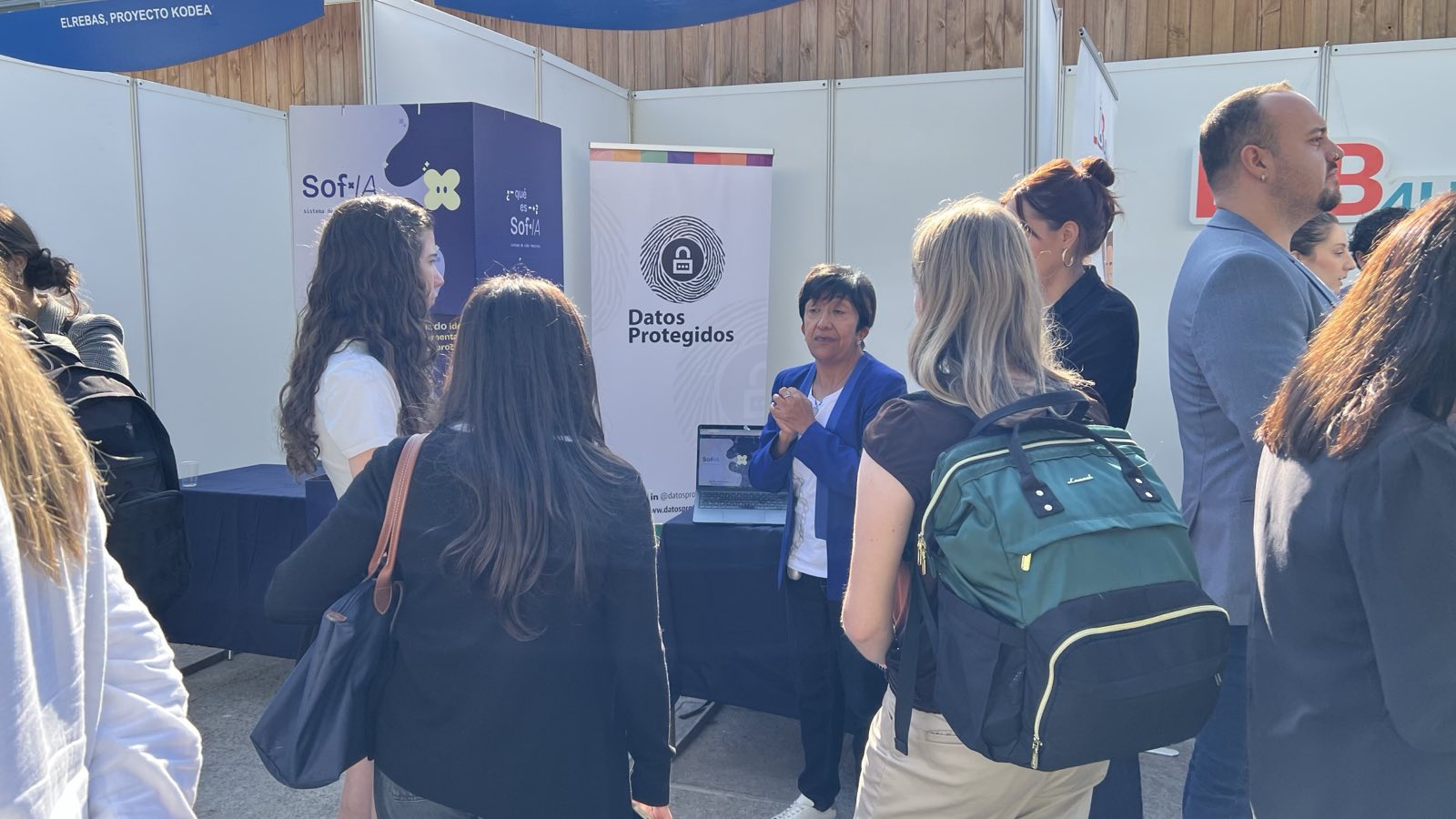
Patricia Peña, co-researcher of the Fondecyt Project on #RegulaciónConvergente, spoke at three important events on artificial intelligence in Chile and Latin America.
With a focus on education, human rights and gender, her interventions highlighted the need for ethical regulations when advancing the use of these types of technologies in the region.
AI and Education
“Back to School with Artificial Intelligence: Driving the Education of the Future Together” is an initiative promoted by the Ministry of Science, Technology, Knowledge and Innovation (MinCiencia) with Universidad Metropolitana de Ciencias de la Educación (UMCE), the National Center for Artificial Intelligence (CENIA) and Fundación Kodea that was presented to the public last Friday, March 7th. On this occasion, Peña presented the prototype of the feminist chatbot Sof*IA, a conversational development for supporting victims and reporting cases of digital gender harassment and violence, particularly against women and diversities.

The presentation intended to show how using technology in a responsible way with a focus on human rights and a gender perspective can contribute to the integrity and care of women and diversities in cyberspace.
The event, whose purpose was to foster an interest in AI and technology in the training of current and future teachers , as stated by Science Minister Aysén Etcheverry, was attended by President Gabriel Boric. He was in charge of presenting “Driving the Education of the Future Together”, an initiative that seeks to strengthen digital competencies and the use of AI in education through four courses imparted with the support of Fundación Kodea.

IACHR: Hearing on Artificial Intelligence and Human Rights
In the context of the hearings organized by the Office of the Special Rapporteur for Freedom of Expression of the Inter-American Commission on Human Rights (IACHR), Patricia Peña spoke on behalf of the Feminist AI Research Network (fA+Ir) for Latin America and the Caribbean. The academic and researcher shared observations and recommendations in three dimensions that the IACHR should consider within its plans for the region.
The first is to include marginalized communities in AI governance decision-making. She emphasized that current models reinforce colonial imaginaries and reproduce speeches that discriminate, make invisible and exclude some population or groups.
Then she explained how it is possible to promote AI as a tool for gender equality, pointing out that it is necessary to rethink the entire lifecycle of an AI-based solution and its governance. Lastly, she stressed the importance of a human rights framework in local norms and regulations. “In our countries, we have confirmed that these [frameworks] often favor corporate interests without safeguarding human rights,” she said.
The academic advises the IACHR that States should guarantee AI governance processes with an analysis of the impact on human rights, promote transparent developments with audits independent from the private sector and adopt impact assessments in key sectors such as justice, healthcare, education, etc. She also suggests restricting the use of AI for mass surveillance and discrimination. She urges the IACHR to prepare a thematic report and an Inter-American regulatory framework that establishes binding standards to make sure that AI respects human rights and gender justice.

Khipu 2025: Latin American Meeting in Artificial Intelligence
Patricia Peña also participated in the #KHIPU2025 conference on digital intelligence in Latin America, held at the Faculty of Administration of Pontificia Universidad Católica. The event gathered students, academics and professionals from various disciplines to discuss innovations, studies and approaches to AI in the region. Peña presented a poster about the prototype of the SOF+IA chatbot and its scope as feminist conversational artificial intelligence.
These events demonstrate the importance of addressing AI from an ethical and gender perspective. The Convergent Regulation co-researcher not only recognized the potential of technology for addressing social problems but also the need to build regulatory frameworks that prioritize human rights and gender justice in the development and application of these tools.

 ENGLISH
  ESPANOL