
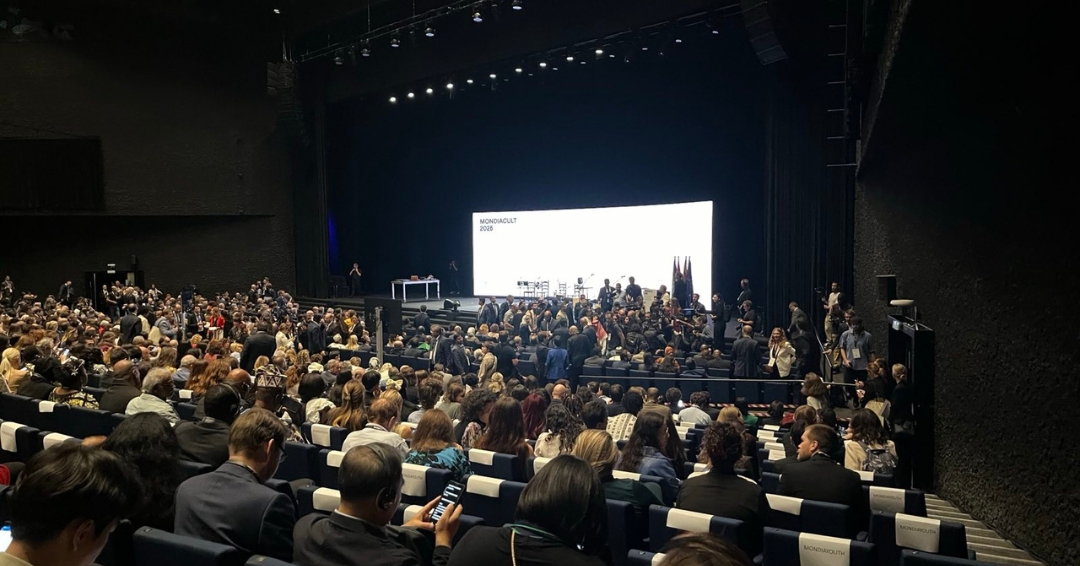
In its latest edition, held in Barcelona, the meeting focused the debate on how to integrate culture within a post-2030 sustainable development framework.
The lead researcher of the Fondecyt Project on #RegulaciónConvergente, Chiara Sáez, attended and took part in Mondiacult 2025, the largest global conference on cultural policy, organized by UNESCO in Barcelona. It brought together ministers, academics, artists and civil society organizations to set the global cultural agenda for the post-2030 period.
MONDIACULT 2025, held from September 29 to October 1, brought together Ministers of Culture from more than 150 countries and a wide range of civil society stakeholders to debate under the slogan “unleashing the power of culture to achieve sustainable development,” structured around six main pillars (cultural rights; digital technologies and AI; culture and education; the culture economy; culture and climate action; and culture, heritage and crises) and two cross-cutting priorities: culture for peace and the impact of artificial intelligence on creation.

The summit produced a ministerial declaration reaffirming the human right to participate in cultural life and positioning culture as a sustainable development pillar. The text dedicates specific paragraphs to the digital transformation and the responsible use of artificial intelligence, defending a human-centered approach based on human rights that guarantees accessibility, cultural diversity and the protection of the intellectual property of creators and artists.
Highlights of MONDIACULT 2025
One of the most relevant launches was the Virtual Museum of Stolen Cultural Objects, an interactive platform aimed at raising awareness about the extent of illicit heritage trafficking, promoting restitution and enhancing citizen education through 3D modeling and virtual reality resources. You can visit the Virtual Museum here. Puedes revisar el Museo Virtual aquí.
Another novelty was the presentation of the First Global Report on Cultural Policies, which compiles indicators and evidence from over 1,200 national reports and 200 case studies. The publication sets out to be a key tool for monitoring the state of the sector and guiding public policymaking. You can review the report here.

Experience at the event
Regarding her experience, Sáez noted: “It was very interesting to be able to participate both in the Mondiacult Conference and the Civic Agora. These events enable an understanding of the high-level debate on cultural policies and the role governments play in guaranteeing cultural rights, including audiovisual diversity.”
Participating in MONDIACULT 2025 strengthens the relationships between research and public policy and offers direct input for the work of the Fondecyt Project, particularly in terms of digital governance, cultural rights and convergent regulation of media technologies.

 ENGLISH
  ESPANOL