
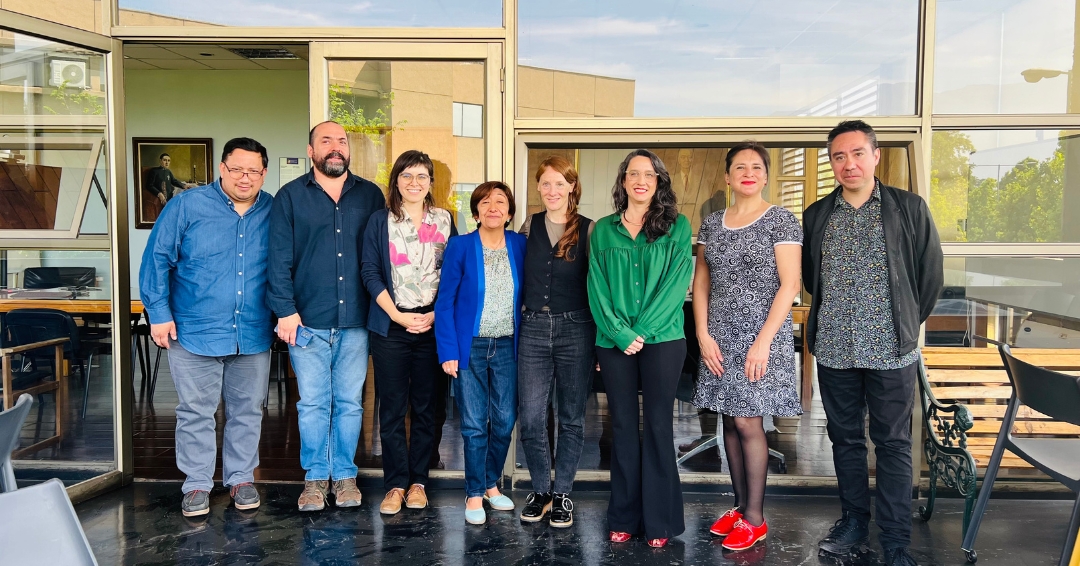
The meeting with international specialists contributed perspectives on communication policies, digital rights and the platformization of cultural industries, key input for updating the Master’s in Social Communication program of Universidad de Chile.
In the context of the curriculum update process of the Master’s in Social Communication program of the Faculty of Communication and Image of Universidad de Chile, an exchange session with international researchers specialized in communication policies and digital rights was held.
The session was entitled “Digital Challenges in the Field of Communication for Post-Graduate Training”, and its purpose was to review emerging lines of research that are reconfiguring the field of contemporary communications.

The activity took place during a meeting of the program’s academic faculty, and it is part of the actions prior to its reopening in 2026 after two years of reformulation. The emphasis was placed on new scenarios resulting from digital transformations, the expansion of platforms and the advancement of artificial intelligence, elements that are modifying both information production modes and cultural and media systems as a whole.
The participants were Marina Pita, Director of Promotion of Freedom of Expression at the Digital Policies Secretariat of Brazil’s Presidency of the Republic with vast experience in public policy and digital rights, and Ana Bizberge, Doctor of Social Sciences from Universidad de Buenos Aires and academic at Pontificia Universidad Católica del Perú, whose work addresses transformations in cultural industries and media regulation.

The conversation addressed issues such as cultural policies in technological convergence contexts, advocacy strategies for civil society organizations, changes in information and cultural consumption, and communication rights in digital environments.
FCEI academic and leader of the Fondecyt Project on Convergent Regulation Chiara Sáez pointed out that the event allowed defining urgent challenges for the field. “Marina Pita underlined the centrality of digital advertising as an economic driver of the Internet, which shifted the discussion toward the role of platforms in illicit practices, transformations in digital consumption and the implications for the sustainability of journalism, including community experiences.”

Regarding Ana Bizberge’s presentation, Sáez indicated that her contribution was key to understanding the “platformization” of cultural industries, a concept that allows analyzing the growing structural power of global platforms in economic, political and sociocultural terms. “Understanding these processes is crucial for observing how they are transforming communication policies and, with this, the frameworks based on which we educate in the graduate program,” she stated.
The input from this event will directly contribute to updating the educational contents of the Master’s in Social Communication program, in which communication policies and digital rights will be central lines of work. The reformulation seeks to strengthen a critical and situated perspective capable of responding to the challenges that new technologies pose for communication in Latin America.
 ENGLISH
  ESPANOL