
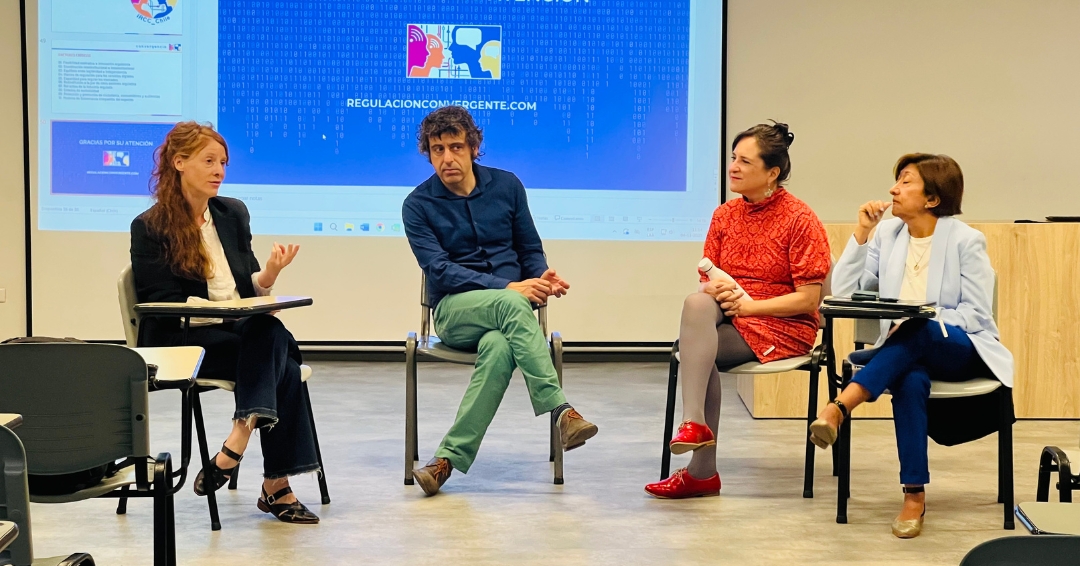
The pre-conference was held for the 11th INCOM Chile Congress, an annual event organized with the Faculty of Communication and Humanities of Universidad Diego Portales (UDP). It was conceived as a specialized academic space for in-depth discussions on key issues of the social communication field.
In this edition, the team of Fondecyt Project N°1230748 on Convergent Regulation led the pre-conference entitled “Regulation of Digital Convergence: Scientific Evidence for Public Policy”, carried out on Tuesday, November 4th at the auditorium of the UDP Faculty of Communication and Humanities.
The activity opened a rigorous dialogue about the challenges of regulating digital convergence in communications based on the results and analyses of two lines of research: Regular Fondecyt N°1230748 and the Transdisciplinary Digital Convergence Regulation Nucleus (VID-UChile).

The inaugural talk was given by Dr. Ana Bizberge, an academic of Pontificia Universidad Católica del Perú, who addressed digital convergence and new audiovisual practices in the context of platforms.
Subsequently, Fondecyt Project researchers Chiara Sáez and Javier García presented the advances and findings achieved in recent years, highlighting case studies and preliminary results.

Then, Patricia Peña reported the developments of the Transdisciplinary Nucleus in terms of digital platform governance in Chile and reflected on the possibility of implementing the Guidelines for the Governance of Digital Platforms proposed by UNESCO in Chile.

The closing was led by international guest speaker MS Marina Pita, Director of Promotion of Freedom of Expression at the Digital Policies Secretariat of Brazil’s Presidency of the Republic. Her intervention contributed a comparative vision based on the Brazilian experience, expanding the debate on digital public policies and regulation in convergence scenarios.

According to Chiara Sáez, the pre-conference fulfilled the goal of advancing the joint systematization of results and perspectives of both projects, strengthening the dialogue and projecting new lines of collaborative work with international researchers.
 ENGLISH
  ESPANOL