
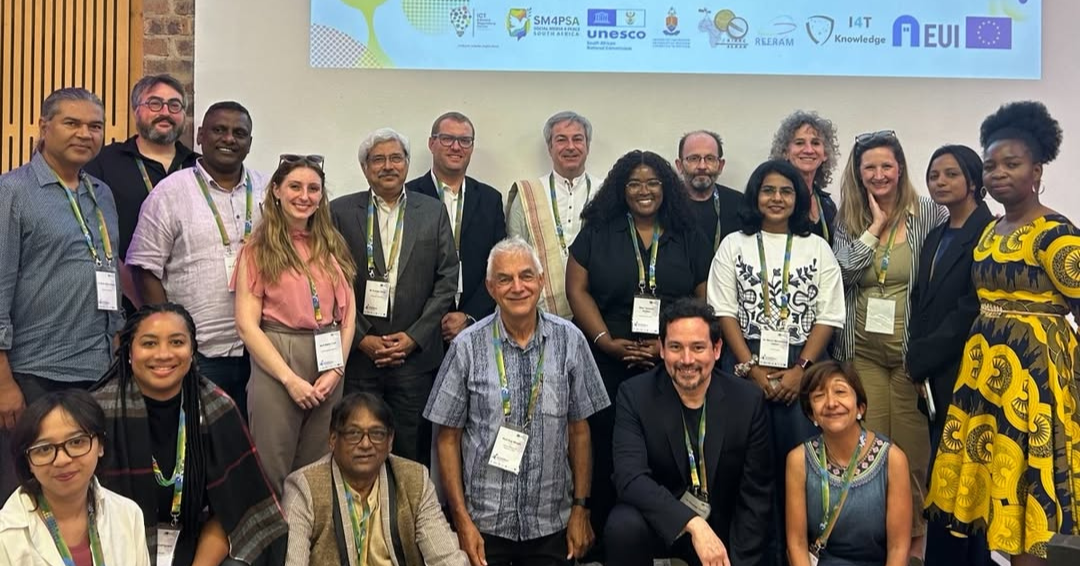
Co-researcher of the Fondecyt Project on Convergent Regulation Patricia Peña participated in the International Conference on Digital Platform Governance held in Pretoria, South Africa.
A roadmap was laid out in the meeting aimed at implementing the guidelines that seek to fight disinformation and protect human rights in the digital environment.
From February 11th to 13th, 2026, the University of Pretoria became a key meeting point for the global debate on the future of the Internet. Organized by UNESCO, the conference marked a milestone by moving from a conceptual discussion of the guidelines to the definition of specific action plans for their implementation.
In this high-level international forum, Patricia Peña, academic at the Faculty of Communication and Image of Universidad de Chile and co-researcher of Fondecyt Project 1230748 on Convergent Regulation, represented a Chilean voice in the global debate on digital platform governance.

Internet For Trust
This conference is the third phase of a global effort that began in 2022 with the Internet For Trust Initiative. After years of deliberation, the current focus is the implementation of the Guidelines for the Governance of Digital Platforms, designed to address critical challenges:
- Disinformation and hate speeches.
- Content moderation under human rights standards.
- Safeguarding freedom of expression and access to information.
“This conference was, effectively, proceeding to complete the action plan. After years of proposals, the objective is to activate roadmaps in different regions of the world,” said Patricia Peña.

AMulti-Stakeholder Commitment
During Day 0, Peña joined the internal meeting of the I4T Global Knowledge Network, a global network of academics and the civil society that supports UNESCO. The Pretoria Proposition for Action emerged from this work, a document that demands:
- Responsibility and accountability of platforms for harmful algorithms.
- Protection of children and youth in digital environments.
- Data transparency for researchers and regulatory bodies.
- A whole-of-society approach in which regulators, the academia and civil society collaborate on supervision.
The event also allowed strengthening the regional network. Peña participated in roundtables with representatives of Latin American governments and the Ibero-American Platform of Audiovisual Regulators (PRAI) to align local challenges with the global standards proposed by UNESCO.
Evidence for Modern Regulation
The participation of the research team was not only through presence but also technical. The Fondecyt Project on Convergent Regulation contributed key evidence on the critical factors that a modern regulatory institutional framework must consider.
In a context in which generative artificial intelligence (AI), deepfakes and algorithmic transparency are redefining media consumption, the Fondecyt project on a convergent regulatory institutional framework of communications in Chile seeks to ensure that regulation is not limited to traditional media but capable of supervising audiovisual platforms and social media efficiently.

 ENGLISH
 ESPANOL