
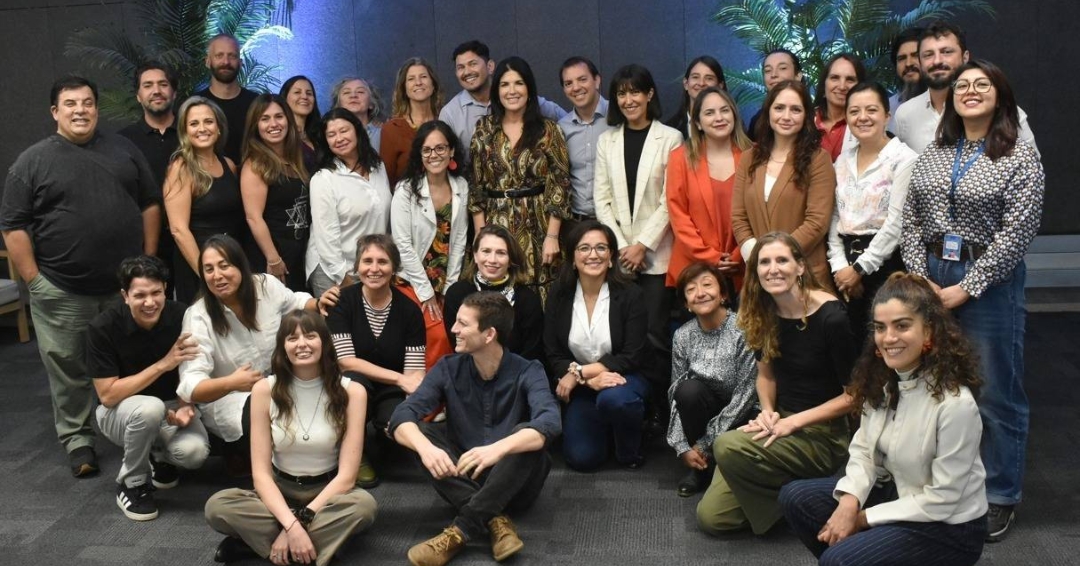
The academia, the public sector, civil society organizations and experts came together in a collaborative space intended for dialogue, evidence sharing and building proposals for the challenges of the digital environment.
Academic and co-researcher of the Fondecyt Project on Convergent Regulation Patricia Peña participated in the event held at the corporate building of Claro Chile, where a vision shared by all attendees was revealed: digital wellbeing does not depend solely on access to technologies but also on factors such as context, digital skills and adult supervision.
The Child Digital Wellbeing Roundtable was promoted by the Center for Studies of Policies and Practices in Education of Universidad Católica (CEPPE UC), Universidad Adolfo Ibáñez and Claro Chile. In this setting, it was agreed to advance measures aimed at strengthening data protection, education in digital citizenship and digital literacy in order to safeguard the rights of children and adolescents and foster a safe, critical and responsible use of technology.

This initiative gives continuity to the Commitment for Children’s Digital Wellbeing signed in late 2025, and it responds to the growing presence of technologies and digital environments in the daily life of children and adolescents.
During the day, the principles that will guide the work of the roundtable were presented, among them the best interests of the child, the protection of personal data and privacy, an age-appropriate design for digital platforms and services, digital literacy and the generation of evidence for decision-making. Additionally, a collaborative process was initiated to outline an intersectoral roadmap with concrete and sustainable actions.
The expected results include the preparation of recommendations for public policy and organizational practices, the promotion of collaborative projects and joint pilots, and contributions to the public debate from an expert and evidence-based perspective with a focus on the digital wellbeing of children and adolescents in Chile.
View from a Potential Regulatory Institutional Framework of Communications
For Patricia Peña, this initiative is particularly relevant for the Fondecyt Project on Convergent Regulation, as it reflects a key multi-stakeholder approach to face the challenges of digital governance.
“This roundtable is interesting for our project because it is configured as a multi-stakeholder initiative that brings together the public and private sectors, the civil society and the academia, all involved in contributing to the debate on how to guarantee safe digital environments for children and adolescents,” she declared.
Peña highlighted that this work covers various levels, from digital literacy and education to the generation of scientific evidence and the development of regulatory frameworks:
“It is about moving forward in the promotion of a critical, conscious and safe use of technologies, the production of evidence that allows designing effective strategies and the strengthening of a digital governance that places data protection and privacy at the center,” she explained.
She also underlined the importance of the private sector’s role in the design of digital environments:
“It is essential that companies make progress in age-appropriate designs both in devices and platforms to prevent risks and overexposure in children.”
The researcher also noted that the initiative is aligned with international standards such as General Comment No. 25 of the Convention on the Rights of the Child, which emphasizes the protection of children’s rights in digital environments.

In this vein, she explained that the principles guiding the roundtable include the best interests of the child, data protection and privacy, digital education, an age-appropriate design, the generation of evidence and co-responsibility among State, private sector, educational communities and families.
Finally, Peña valued the project’s participation in this space:
“For the Fondecyt project, it is very relevant to be part of this event, as it allows contributing with research to the analysis of the role of institutions, regulatory frameworks and digital governance in this area.”


 ENGLISH
 ESPANOL