
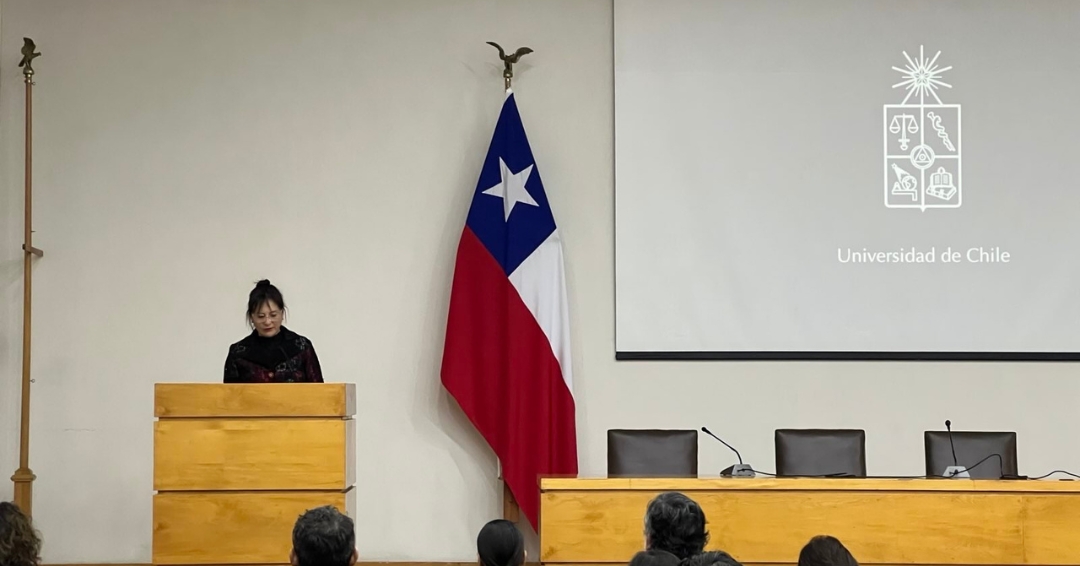
In the context of the 32nd anniversary of World Press Freedom Day, Universidad de Chile and the UNESCO Office in Santiago presented the Guidelines for the Governance of Digital Platforms in the country, creating a space for reflection on the role of States, the civil society and platforms in disinformation and the protection of freedom of expression.
On the morning of Tuesday, May 6th, the Transdisciplinary Digital Convergence Regulation Nucleus, the Research and Development Vice-Rectory of Universidad de Chile and the Internet Society Chile Chapter, con el apoyo de la Oficina Regional de la UNESCO en Santiago and the Faculty of Communication and Image (FCEI) de la Universidad de Chile, commemorated the 32nd anniversary of World Press Freedom Day at the Eloísa Díaz Hall of our Central House with the event Digital Platform Governance and New Challenges for Freedom of Expression. The activity was conducted one year after our country hosted the international ceremony, which this year was held in Brussels, Belgium.
Although the topic of this version of the international UNESCO conference was generative artificial intelligence and journalism, the academics that organized this event decided it was not possible to talk about this without first posing the question of platform governance, a concept that was explained by the FCEI academic and director of the Transdisciplinary Digital Convergence Regulation Nucleus, Chiara Sáez: “We always talk about governance as the regulation of different levels , where various actors with varying capacity for interference participate. There are two very important ones: the platforms themselves and the States. But there are also other stakeholders who participate in this discussion, such as the technical community, academics, the civil society and communicators."

The person in charge of the opening remarks at the inauguration of this meeting was the director of innovation of the Research and Development Vice-Rectory of Universidad de Chile, Anahí Urquiza. She expressed her concern about the vulnerability in which current digital dynamics leave citizens: “When we are dealing with the fact that information among people is mediated by countless platforms and tools that, to some extent, create these echo chambers,, these bubbles that are extremely dangerous -even more so when they are manipulated by certain sectors or when they are at the service of big corporations and businesses-, we are left in a highly vulnerable position because it is very difficult to meet a different other.”

The directora de la Oficina Regional de la UNESCO en Santiago y de Coordinación con las Naciones Unidas para América Latina y el Caribe, Esther Kuisch Laroche, also referred to these threats, stating that artificial intelligence is no longer a future promise but a reality that is transforming the way in which information is generated, distributed and consumed in real time: “Even though these technologies have many advantages for journalism, (…) they also represent very important challenges. The lack of transparency of algorithms, automated biases, the concentration of digital power, threats to information diversity and fundamental rights are of great concern to us. And I would like to open a small parenthesis here. When we speak of biases (…) online , the existing information is based on more or less 100 languages, , but there are over seven thousand languages in the world. This already shows us there is a great problem here because what happens with all of those languages that also represent different ways of looking at life?."

Guidelines for the Governance of Digital Platforms
The initial activity was in the hands of the senior specialist of the UNESCO Communication and Information Program, Ana Cristina Ruelas, who presented the document created by this global organization called Guidelines for the Governance of Digital Platforms. Its purpose is to safeguard freedom of expression and information access rights while addressing disinformation, hate speech and conspiracy theories.
The presentation was mediated by academic Chiara Sáez, who guided it and asked expert Ana Cristina Ruelas how Latin American countries can aim at governance with a regionalist perspective. The specialist said it requires joint work by the countries to unite views but also interventions in each country’s jurisdictions.

The UNESCO Guidelines for the Governance of Digital Platforms, published in late 2023, propose a collaborative, human rights-based approach to face the challenges and impacts of digital platforms in relation to freedom of expression, access to information and cultural diversity. “The transformative role that digital platforms have played in advancing human rights is undeniable. Yet the same digital platforms that have democratized access to knowledge and culture, and fostered global connection, have also become ecosystems of misinformation, disinformation, ideological polarization, and incitement to violence, discrimination, and hate. Such features have undermined democracies and threatened human rights across the world,” stated UNESCO in the original presentation of the document.
El proceso para llegar a estas propuestas se inició el 2022 a partir de un diálogo mundial sobre regulación de plataformas digitales. En noviembre de 2023, la UNESCO publicó las Directrices tras tres consultas abiertas, más de 10.000 comentarios y la participación de personas de 134 países, resaltando la necesidad de mecanismos de gobernanza abiertos y con la participación de multiple stakeholders.
UNESCO suggests that all stakeholders share the responsibility of maintaining a favorable environment for freedom of expression and the right to information while also ensuring an open and safe environment for users and non-users. The Guidelines describe a set of duties, responsibilities and roles for States, digital platforms, intergovernmental organizations, the civil society, media, the academic world, the technical community and other stakeholders to create an environment in which freedom of expression and information are at the center of the governance processes of digital platforms.
It also promotes media literacy as an essential tool for empowering citizens and strengthening resilience in the face of harmful contents circulating online, in addition to underlining the importance of proportionate, responsible and collaborative regulations in which platforms must be held accountable, adjust their algorithms to human rights standards and promote media and information literacy, particularly among more vulnerable groups.
Present and Future Challenges of Digital Platforms
The second part of the event focused on the panel discussion “Present and Future Challenges for the Governance of Digital Platforms in Chile””, which was moderated by the FCEI academic and alternate director of the Transdisciplinary Digital Convergence Regulation Nucleus, Patricia Peña,. The panel had several members: the attorney and president of the National Television Council, Mauricio Muñoz; the academic at the Faculty of Government of Universidad de Chile and member of the Electoral Service’s board, María Cristina Escudero; the journalist and researcher at the Observatory of the Right to Communication, Jorge Avilés; and the psychologist and researcher at the Center for Advanced Research in Education (CIAE) of Universidad de Chile, Patricio Cabello. All of them reflected on the proposed topic based on data and studies.

At the end of the day, the academic at the Faculty of Communication and Image, Patricia Peña,referred specifically to the challenges we are currently facing in Chile on the verge of the executive and legislative elections: “During electoral times, what we have seen globally, and this has been a warning for the past two years, is that we will see more and more information circulating that is manipulated or altered in some way by generative artificial intelligence. For example, a video of a candidate saying something that, strictly speaking, they never said. Today this is not necessarily regulated on digital platforms, which, let’s not forget, are companies."
Operationalization of the Guidelines in Chile
In the Chilean context, the Transdisciplinary Digital Convergence Regulation Nucleus, a project born under the auspices of the Research and Development Vice-Rectory of Universidad de Chile, has started to translate these guidelines into the local reality with a particular emphasis on the protection of children, marginalized communities, journalists and electoral processes. The research, led by FCEI academics Chiara Sáez and Patricia Peña, reveals the need for a convergent institutionalism and regulatory capacities with democratic legitimacy. In this vein, digital literacy and rights education are central pillars, along with the strengthening of digital infrastructure and technological sovereignty.
Review the activity in full on the YouTube channel of the Internet Society Chile Chapter.
***
 ENGLISH
  ESPANOL