
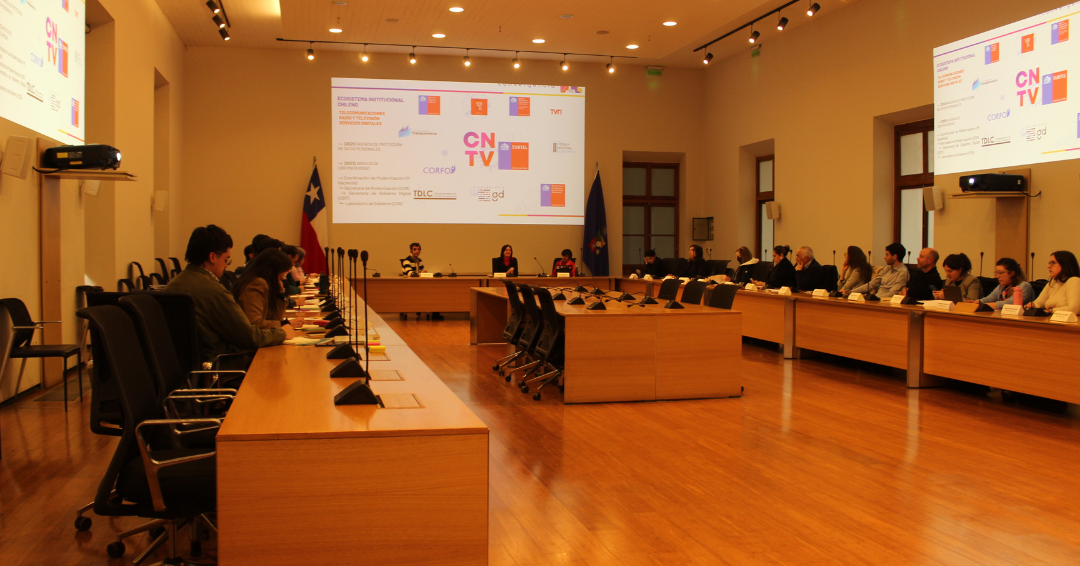
Last Tuesday, September 2nd, Fondecyt Project N°1230748 held its national scientific meeting at the Valentín Letelier Hall of the Central House of Universidad de Chile. It gathered academics, government representatives, and national, regional and civil society experts to share the research advances and open the debate about the need for a convergent regulatory institutionalism in the country.
The Challenge of Digital Convergence
Technological progress and digitalization have transformed the communications ecosystem around the world. Today, broadcasting, telecommunications and digital services interact inseparably, generating regulatory loopholes, tensions in the competition between traditional actors and platforms, and new risks for the rights of users and audiences.
In this context, the research seeks to contribute evidence to think about a Convergent Regulatory Institutionalism of Communications (IRCC) in Chile capable of responding to transparency, pluralism, innovation and fair access challenges in digital environments.

International Evidence: Four Case Studies
The research team has systematized and analyzed regulatory experiences from Colombia, Mexico, the United Kingdom and Canada that offer valuable lessons for the Chilean context:
- United Kingdom (Ofcom): The creation of the Digital Regulation Cooperation Forum (2020) and the recent Online Safety Act (2023), which protects minors and users from harmful content online, are noteworthy.
- Canada (CRTC): It introduced the Online News Act (2023), which forces digital platforms to negotiate fair compensation with news media.
- Colombia (CRC): implementó sandbox regulatorios para innovar en ámbitos emergentes de la convergencia digital.
- Mexico (IFT / ATDT / CRT): It offers lessons about autonomy and independence based on its process for reforming and dissolving the Federal Telecommunications Institute (IFT) in 2025.
Methodological Developments: A Single Measurement System

One of the project’s main achievements is the construction of a multidimensional measurement system composed of 132 variables. This instrument allows assessing regulatory institutions based on principles such as fair competition, communication rights, autonomy, transparency, interinstitutional coordination and digital sovereignty.
Critical Factors for Chile
The study has identified a set of strategic factors that must be considered in the design of a convergent regulatory institutionalism:
- Policy flexibility and regulatory innovation;
- Inter- and intra-institutional coordination;
- Balance between political legitimacy and technical independence;
- Protection of cultural diversity and broadcasting from the hegemony of telecommunications;
- Active role of the industry through co-regulation mechanisms;
- Exclusivity of positions and post-mandate restrictions to safeguard autonomy;
- Shared governance models for the radio spectrum.
Reach and International Networks
The project has also strengthened its international reach. In 2024, Universidad de Chile joined UNESCO’s I4K Internet for Knowledge network and created the Transdisciplinary Digital Convergence Regulation Nucleus (VID-UChile) to adapt the digital platform governance guidelines to the Chilean context.

A Contribution to the National Debate
The scientific meeting not only allowed sharing research advances but also receiving expert feedback to enrich the work in progress. In the words of the team’s researchers, it is about “opening an informed and plural dialogue that makes it possible to think of a robust, democratic institutionalism adapted to the challenges of digital convergence in Chile”.

 ENGLISH
  ESPANOL